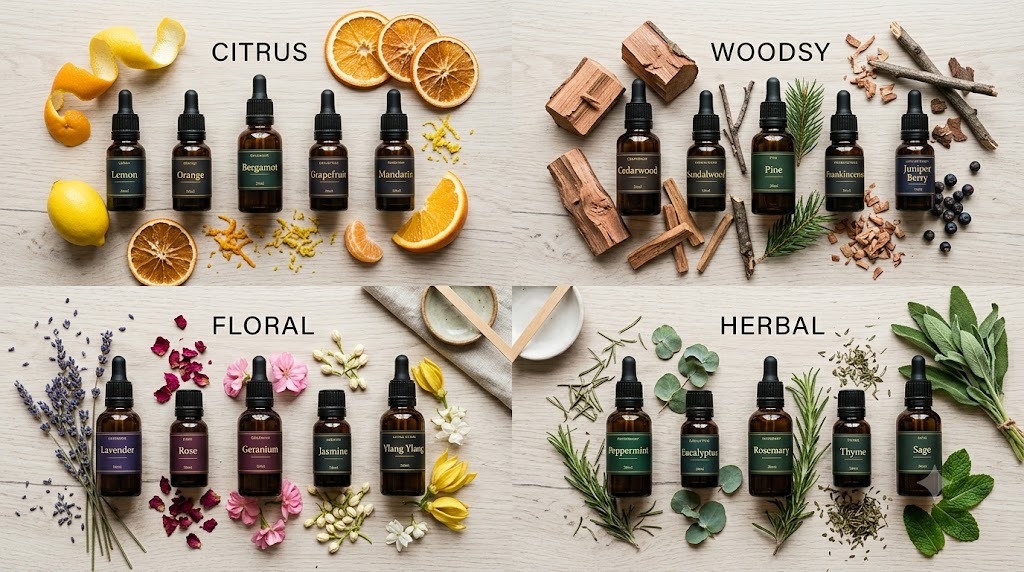
Every oil we make belongs to one of six scent families - citrus, floral, woody, herbal, camphorous and earthy - and the fastest way to choose an essential oil is to pick the family first and the bottle second. Decide how you want a room or sauna to feel, then match the family below. Prefer questions to reading? Our scent finder quiz is the interactive version of this post.
| Family | Smells like | Reach for it when | Best fit |
| Citrus | zest, sunlight, clean air | mornings, stale rooms | diffuser |
| Floral | petals, soft sweetness | evenings, winding down | both |
| Woody | forest, resin, timber | calm, focus, winter | sauna |
| Herbal | green leaves, apothecary | fresh but not sweet | depends on the oil |
| Camphorous | menthol chill, crisp air | a full fresh reset | sauna, low doses |
| Earthy | soil, roots, dark wood | depth, slow evenings | diffuser and blends |
Citrus - bright, clean, lifting
Citrus oils smell the way an open window feels: sharp zest, light sweetness, instant clean. They are top notes: their molecules are the lightest, so they announce themselves at once and fade first. Lemon essential oil is the crispest of the family, pure peel and sunlight; bergamot essential oil is rounder, with a soft floral-tea edge that works into the evening.
Reach for citrus on grey mornings, in stale rooms, or when you need a scent no guest will object to. The diffuser is their best home: 3-5 drops, topped up as the scent fades. In the sauna they flash off the stones quickly - treat 3-5 drops in 500 ml of water as a bright opener, not the whole session. One caution: lemon and bergamot are photosensitising, so keep them off skin before sun.
Floral - soft, round, romantic
Florals are the heart of perfumery: petal-soft, rounded, slightly sweet, ranging from barely-there to heady. This is our largest family.
- Lavender essential oil - herbaceous-floral and the easiest to live with; the lavender guide covers its many uses.
- Rose essential oil - deep, classic, slightly jammy.
- Neroli essential oil - orange blossom, bright and honeyed, the freshest floral.
- Jasmine essential oil - rich, warm and intense; one drop does the work of three.
Reach for florals in the evening, or when you want a home to smell finished rather than merely clean. Lavender is the family's sauna ambassador: 3-5 drops in 500 ml of water gives a gentle, softening steam. Rose, neroli and jasmine belong in the diffuser at the low end of 3-5 drops, because heat amplifies their sweetness fast.
Woody - warm, grounding, calm
A Nordic forest in a bottle: dry timber, fresh resin, green needles, cool air. Woods add depth and stillness. Pine essential oil is fresh and resinous, spruce essential oil is softer and greener, and cedarwood essential oil is the driest and warmest - almost pencil-shavings cosy.
Reach for woods for calm focus, a winter-cabin mood, or a scent that feels like it belongs to the building itself. This is the definitive sauna family: pine or spruce at 3-5 drops per 500 ml smells like the sauna's own wood come alive. Torn? Our comparison of birch, pine and eucalyptus for sauna settles it, and the complete sauna scents guide covers the whole ritual. In the diffuser, cedarwood is the quiet achiever - present for hours, never shouting.
Herbal - green, aromatic, grown-up
The herbal family smells like a kitchen garden beside an old apothecary: green, complex, noticeably less sweet than florals. Clary sage essential oil is soft, nutty and slightly musky - the gentlest herb we carry. Oregano essential oil is its opposite: warm, pungent and spicy, closer to the spice rack than the bouquet.
Reach for herbs when florals feel too sweet and citrus too simple. Clary sage suits both sauna (3-5 drops per 500 ml) and diffuser. Oregano demands respect: 1-2 drops in sauna water is plenty, it dominates a diffuser blend just as quickly, and it is never ingested or used neat on skin.
Camphorous - cool, piercing, fresh
The wake-up family: menthol chill, crisp air, that unmistakable spa-corridor sharpness. Eucalyptus essential oil is the classic - the eucalyptus guide has the full picture. Peppermint essential oil is icy and green, tea tree essential oil reads clean rather than cold, and camphor essential oil is the sharpest and most old-school of the four.
Reach for these before a morning sauna, after exercise, or when a space needs a hard reset. They are sauna naturals but potent: 2-3 drops of eucalyptus, peppermint or tea tree per 500 ml of water, and only 1-2 drops of camphor, which is never ingested. The sauna dosage guide has the full chart, and the same restraint applies in infrared cabins, where there are no stones and less moving air. Two honest notes: these are scents, not treatments - and tea tree is toxic to cats and dogs, so skip it in homes with pets.
Earthy - deep, dark, lasting
Patchouli essential oil has this family to itself and earns it: damp soil, dry roots and dark wood with a faint sweetness underneath - closer to forest floor than flower. It is our longest-lasting oil - a base note that hangs on for days and improves as it dries.
Reach for patchouli on slow autumn evenings, or as the anchor in a blend - one drop under a citrus or floral stops the whole thing evaporating. In a diffuser, 3-5 drops outlast every other oil here. In the sauna it is unusual but interesting, a cousin of the tar-and-smoke depth we explore in Estonian smoke sauna scents; start at the low end of 3-5 drops per 500 ml, because its voice carries.
How to blend across families
Start with one oil and live with it for a week. When you are ready to blend, borrow the perfumer's shortcut - the families map neatly onto note roles:
- Top: citrus and camphorous - the first impression, gone within the hour.
- Heart: floral and herbal - the character of the blend.
- Base: woody and earthy - the depth that remains.
Cross-family pairs to try: lemon with cedarwood, lavender with spruce, bergamot with patchouli. In the sauna, keep a blend's total drop count within the range of its strongest oil, and if the steam ritual itself is new to you, start with our explainer on löyly, the Finnish steam.
FAQ
Q: Which scent family is best for the sauna?
A: Woody - pine and spruce echo the wood of the room itself. Camphorous oils are the classic morning alternative at lower doses; citrus and delicate florals fade fastest in heat and suit the diffuser.
Q: Can one oil belong to two families?
A: The edges blur. Bergamot is citrus with a floral streak, lavender is floral with a herbal streak, and tea tree sits between herbal and camphorous. We sort by dominant character; an oil that pulls you two ways is a ready-made blending hint.
Q: Are these oils safe around pets?
A: Not all of them. Tea tree is toxic to cats and dogs, and many oils are unsafe around cats. Diffuse only in ventilated rooms your pet can leave, never apply oils to animals, and ask your vet before scenting a home with pets.
Q: Do fragrance oils fit these families too?
A: Synthetic fragrance oils imitate the same families but behave differently in heat - see our take on whether fragrance oils belong in saunas. Everything on this page refers to pure essential oils.
That is the whole map: six families, sixteen oils, no wrong door. If you already know your family, browse the full collection and start with a single bottle. Still torn? Take the scent finder quiz - it asks how you want your home or sauna to feel, and hands you an oil to start with.
Leave a Reply